
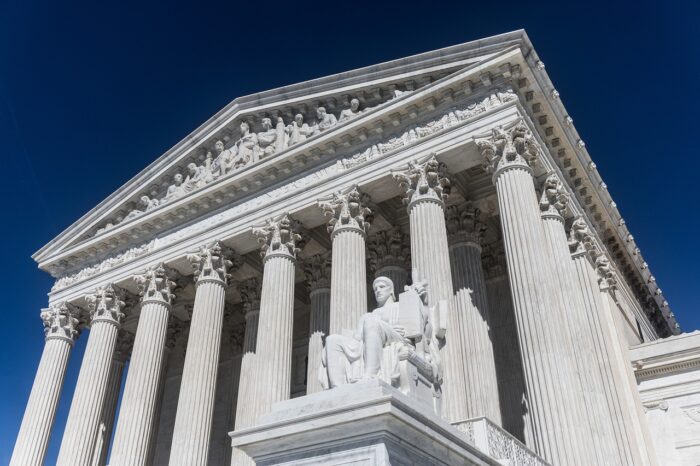
It’s been a busy couple of weeks for the U.S. Supreme Court: First, it announced Tuesday it will hear cases challenging assault weapons bans in Connecticut and Cook County, Ill. Arguments will be heard in the fall, with a decision likely next year.
Both sides of the assault weapons debate have been waiting for the Court to take such a case since the 2022 Bruen decision, which said gun regulations must conform with the nation’s “historical tradition of firearm regulation.” Whether assault weapons can be considered to fall under that guidance is hotly debated. The earliest assault weapon restrictions were enacted in the District of Columbia as part of a 1932 federal law.
Assault weapons bans are in effect in about a dozen states, and cities including New York, Los Angeles, Washington, D.C.—and Denver. The U.S. Department of Justice recently sued Denver over its ban.
Part 2: The Court last week struck down a Hawaii law banning the carry of guns on private property without express permission of the property owner. The overturned law also created a list of ‘sensitive places’ where guns may not be carried, such as beaches and restaurants that serve alcohol. The Supreme Court decision, however, focused mainly on private property rights. Private property owners may still ban firearms on their property, but must display a sign to do so, rather than that being the default position.
Colorado also has a ‘sensitive spaces’ bill, passed in 2024. This decision leaves that law in place, at least for now.
Part 3: The Court on June 18 said the government may not restrict the gun rights of casual drug users. Federal prosecutors had brought charges against Ali Danial Hemani, a casual marijuana user, after the FBI found a handgun during a search of his Texas home in 2022. Federal law makes it a crime for any person who is “an unlawful user of or addicted to any controlled substance” to possess a firearm.
However, the Court ruled that casual use of drugs does not necessarily make a person dangerous. “The court has sent a strong message that the government cannot criminalize the conduct of large numbers of people by making categorical and unfounded assumptions about whether they are dangerous,” Cecillia Wang, legal director of the American Civil Liberties Union, which represented Hemani, said in a statement.
The law is the same statute that Hunter Biden, the son of former President Joe Biden, was convicted under in June 2024 before his father pardoned him.
Experts say these rulings could be construed as offering a path to those who would further undo existing laws: For example, the Hawaii ruling took a narrow view of the questions raised and ruled only on that law without striking down laws in other states. The way in which the majority interpreted the Hawaii law’s constitutional questions offers both a roadmap to those challenging similar laws and guidance for lower courts in other cases.