
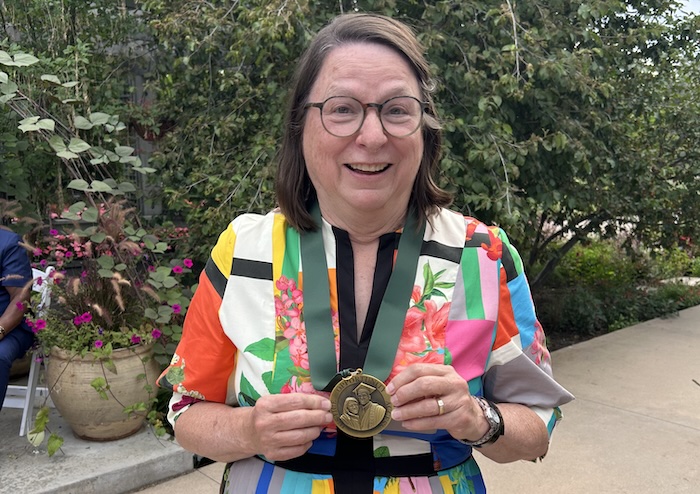
by Eileen McCarron
Retiring President, Colorado Ceasefire Legislative Action
On April 20, 1999, the political environment of Colorado changed dramatically: At Columbine High School in Littleton, two young men entered their high school and slaughtered 12 fellow students and a teacher. The state was stunned, as was the nation.
Prior to that date, gun laws in Colorado were few. The political alignment of a Republican governor and legislature had gun-rights enthusiasts lined up to enact even looser provisions. These all were scuttled after the massacre.
Despite Columbine, the 2000 Colorado General Assembly failed to enact meaningful ‘gun control’ legislation. SAFE Colorado took a Closing the Gun Show Loophole ballot issue to the voters, who approved it with a 70% vote. Simultaneously, Colorado Ceasefire was born with an intent to remove from office those legislators who blocked meaningful reforms. We successfully turned six seats that year.
Colorado was slow to give up its western ways, and it was not until the 2012 Aurora Theater Massacre and the murder of 20 first-graders and six educators in Connecticut that Colorado leaders awakened to the connection between gun violence and gun laws. In 2013, the dam broke: Five measures were enacted, including universal background checks, a large capacity magazine ban, and domestic violence relinquishment of firearms. Critical legislators for these bills were Representatives Beth McCann and[EM1] Rhonda Fields, whose son, Javad, had been gunned down in 2005. That year, Ceasefire was joined in its efforts by national groups who saw that Colorado was fertile ground for change. A coalition of groups (Colorado Coalition Against Gun Violence) was formed, and the Colorado Faith Communities United (CCFU) emerged from that coalition.
Gun enthusiasts were none too happy with this turn of events: One day, they packed the State Capitol halls with people and circled the building with honking trucks while a plane flew overhead with a streamer reading “Hick, don’t take our guns.” Upon the enactment of the laws, these enthusiasts immediately began a recall effort, which eventually led to the loss of three senators, including Senate President John Morse.
After the recalls, legislators were averse to considering additional gun reforms, until December 31, 2017 when a mentally ill young man ambushed and killed a Douglas County sheriff’s deputy. The following legislative session, Colorado Ceasefire worked to enact an Extreme Risk Protection Orders law—which could have been used to take away that killer’s weapon. It passed the House, but failed in the Senate— becoming a major campaign issue in the 2018 ‘blue wave’ election. The following session, ERPO became law, with Tom Sullivan as the prime House sponsor. Sullivan’s son Alex had been murdered at the Aurora Theater. Thirty-nine counties declared themselves ‘sanctuary counties,’ and indicated that they would not enforce the ERPO law—but by 2025 ERPOs had been filed in 72% of them.
The recall resistance was broken, and GVP bills were back on the table. In 2021, three bills were already underway when the March 22 Boulder King Soopers shooting took 10 lives. Another three bills were added. Enacted were six new laws, including safe storage, expanded background checks, establishing the Office of Gun Violence Prevention, and a repeal of local-law preemption.
The Club Q shooting in November 2023 showed that gun massacres still afflicted Colorado, and in the following years (2024-2026) nearly another 30 GVP bills became law. Major regulations were enacted, including minimum age; standardized concealed carry classes; prohibitions in sensitive spaces; gun dealer permitting; voluntary no-buy; required permits for assault weapons; gun show requirements; and restrictions on social media and ammunition sales. In 2025 a firearms excise tax dedicated to victim assistance received approval by 55% of Colorado voters.
It has been a long, 26-year road for Colorado Ceasefire, full of heartbreaking setbacks and inspiring successes. I am confident that those successes will continue under the strong leadership of Executive Director Laney Sheffel, Outreach leader Sam Cole, and Legislative Action co-chairs Cooper Dayton and Lydia Waligorski. It goes without saying that none of this would be possible, in the past or future, without your steadfast support, for which I am eternally grateful.
On a personal note, I arrived here in 1999 from Texas, where I had worked unsuccessfully to stop concealed carry. That the 2003 Colorado concealed carry law is still with us is my biggest regret.
It is amazing to me how very much Colorado has evolved in these 27 years, becoming a national leader in gun violence prevention. I am grateful to Ceasefire and its hardworking boards, including the omnipresent Tom Mauser—whose son Daniel was murdered at Columbine—for capitalizing upon our state’s evolution and working to enact so many of the gun violence prevention laws that have made us safer.
My vision for the future of Colorado is that it strengthens enforcement, emphasizes suicide prevention, and enacts a requirement for training and a permit to purchase a firearm. The data are clear: Stronger laws mean fewer gun fatalities. Colorado is on that path, and with bold leadership, I believe that gun violence may someday become a stranger to every Colorado family.